
Key takeaways
- – 95% of enterprise generative AI pilots fail to deliver measurable financial impact, yet most organizations keep launching new pilots without changing how they work.
- – The gap between piloting AI and scaling it comes down to three missing pieces: clear ownership, governance that moves at business speed, and feedback loops that improve the system over time.
- – Organizations that redesign workflows around AI – rather than bolt tools onto existing processes – see financial returns roughly four times higher than those that do not.
Most organizations I work with have run at least one generative AI pilot. Several have run a dozen. Yet when I ask leaders how many of those pilots are now part of normal operations, the room gets quiet. The pilots worked in the demo. They impressed the steering committee. Then they sat in a sandbox and faded. This is the dominant pattern in enterprise AI right now – not failed technology, but a failure to operationalize it.
MIT’s NANDA Initiative published a study in 2025 based on 150 executive interviews, 350 employee surveys, and 300 public AI deployments. The finding was stark: only 5% of enterprise generative AI pilots achieve rapid revenue acceleration. The other 95% stall. That is not a technology problem. The models work. The problem is organizational – vague goals, poor workflow fit, and no clear path from experiment to standard practice.
Why pilots stay pilots
The core issue is not what organizations try, but how they try it. Most AI pilots are scoped to prove a concept, not to redesign work. They show that a tool can summarize documents or draft emails. They do not answer the harder question: how does this change the way this team delivers results, day after day?
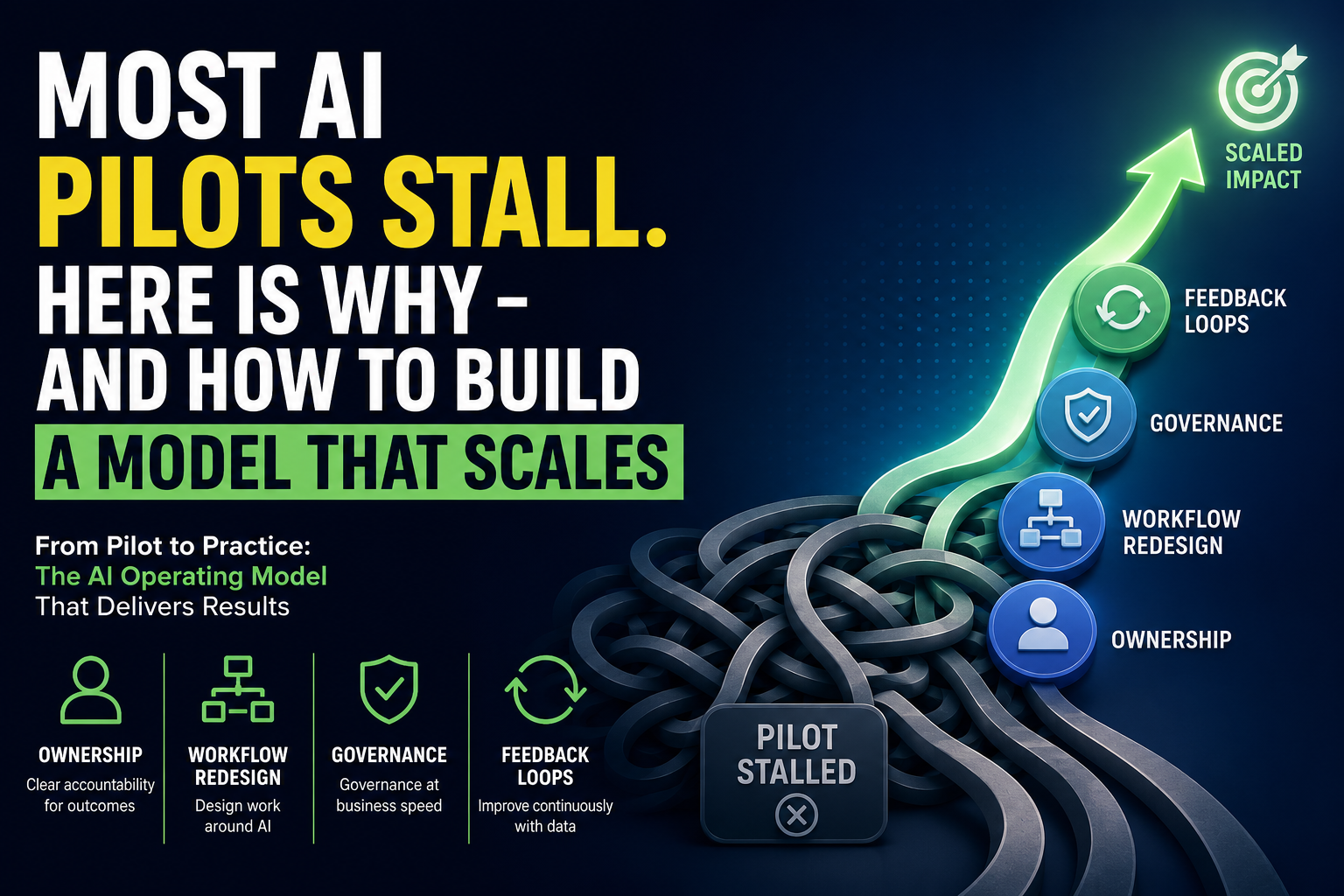
Three patterns cause pilots to stall. First, no one owns the outcome. A central IT team builds the tool, a business unit uses it occasionally, and no one is accountable for adoption or improvement. Second, governance is built for the pilot stage – slow, approval-heavy, and disconnected from how the team actually works. Third, there is no feedback loop. The tool ships and sits. No one tracks whether outputs are accurate, whether staff are using it, or whether it is actually saving time.
McKinsey’s 2025 State of AI survey found that only about one-third of organizations have moved beyond piloting to scale AI across any function. Among those that have, the most consistent differentiator was not the model they used or the vendor they chose. It was workflow redesign – specifically, whether they had rebuilt the process around AI rather than layering AI on top of the old process.
The AI operating model: a framework for moving from pilot to practice
In my work with mid-market organizations across manufacturing, healthcare, and higher education, I have seen a consistent pattern among those that succeed. They treat AI as an operating model decision, not a technology decision. That means getting four things right simultaneously: ownership, workflow design, governance, and feedback loops. The chart below shows how organizations typically distribute their focus – and where most of the value actually lives.
| AI transformation component | Share of value |
|---|---|
| Algorithm / model | 10% |
| Technology backbone | 20% |
| People, process and workflow redesign | 70% |
Source: BCG, 2025. The model (10%) and the tech stack (20%) are table stakes. Seventy percent of value comes from redesigning how people work.
This ratio – 10% model, 20% technology, 70% people and process – comes from BCG’s case work across hundreds of companies. It tells you something important: organizations that spend most of their effort selecting the right model and building the infrastructure are focusing on the minority of the value. The majority lives in the harder, slower work of redesigning roles and processes.
Here is how each layer of the operating model needs to work.
Ownership. Every AI use case needs a named business owner, not a technology owner. That person defines the outcome the AI is responsible for, tracks whether it is being achieved, and escalates when the system is not working. In my experience, the single most common reason a pilot does not scale is that no one in the business feels accountable for its results. Central AI teams can build and support, but a line manager must own.
Workflow redesign. BCG’s 2025 AI at Work survey found that only half of organizations have moved from deploying off-the-shelf AI tools to actually redesigning workflows end-to-end. Those that do redesign see significantly more time saved per employee and stronger financial results. The key question is not “what can we automate?” but “if we were designing this process from scratch with AI available, how would it work?” Those are different questions, and the second one is the right one.
Governance at business speed. Most governance frameworks are designed for annual risk reviews and procurement cycles. AI requires governance that works week to week – prompt libraries approved in advance, a risk tier system that lets low-risk uses move fast and applies extra scrutiny only to high-stakes decisions, and clear rules about when a human reviews an AI output before it is acted on. McKinsey’s 2025 research on agentic organizations puts it plainly: governance must become real-time, data-driven, and embedded – not a periodic, paper-heavy exercise.
Feedback loops. A repeatable AI operating model improves over time. That only happens if you track the right things. Leading indicators – active users, tasks completed by AI, accuracy rates – tell you whether the system is being used and working correctly. Lagging indicators – time saved, cost reduced, revenue influenced – tell you whether it matters. Most organizations track neither consistently. McKinsey found that tracking explicit AI KPIs is still uncommon, even though it is one of the strongest predictors of long-term business impact.
The 5% who scale: what they do differently
The organizations that move past pilot mode share a few habits worth naming directly.
They focus narrow and prove fast. The 5% that achieve rapid acceleration do not pursue enterprise-wide transformation on day one. They pick one process, one team, one measurable outcome. They prove value in 60 to 90 days, use that result to build internal confidence, then expand. Broad mandates with vague goals are where AI budgets go to die.
They build for reuse. McKinsey’s operating guide for gen AI recommends that IT teams build shared components – prompt libraries, standard agents, common data pipelines – that any business unit can draw on. One European bank used this approach to implement 80% of its core AI use cases in three months. Without shared infrastructure, every team rebuilds from scratch and governance breaks down.
They empower line managers, not just central labs. MIT’s research found that empowering line managers to drive adoption – rather than relying solely on a central AI team – is a key factor in success. The people closest to the work know where AI can actually help. Giving them structured ways to propose, test, and scale use cases within guardrails is more effective than top-down deployment of tools they did not ask for.
BCG’s 2026 research found that only about 5% of organizations have managed to achieve substantial financial gains from AI – and those companies show total shareholder returns roughly four times higher than AI laggards. What separates them? They see AI as a workforce and process transformation first, and a technology investment second.
What leaders should do now
Audit your pilots by outcome, not activity. For every active AI pilot, ask: who owns the business result, and what is it? If the answer is “the IT team” or “we are still measuring,” the pilot has not left the lab. Assign a business owner with a defined outcome and a 90-day target. Kill the pilots with no owner or no clear metric – they are consuming attention without producing value.
Build a two-tier governance structure. Create a simple risk tier system. Tier one covers low-risk, high-volume uses – summarization, drafting, internal search – that can be pre-approved and moved fast. Tier two covers high-stakes uses – decisions affecting customers, patients, or compliance – that require human review and a defined sign-off process. Most of your use cases belong in tier one. Having a clear framework for both lets teams move quickly without cutting corners where it matters.
Redesign one end-to-end process, not ten discrete tasks. Choose a process that is high-volume, well-documented, and owned by a willing business leader. Map the full workflow from input to outcome, identify where AI replaces a step entirely versus where it assists a human, and redesign the roles around the new flow. One redesigned process that works is worth more than ten automations bolted onto an unchanged workflow.
Instrument everything from day one. Before you deploy, define three metrics: one adoption metric (are people using it?), one quality metric (is the output reliable?), and one business metric (does it change the result that matters?). Review them monthly. If adoption is low, the problem is change management. If quality is low, the problem is the prompt or the data. If the business metric is flat, the problem is the process design. You cannot improve what you do not measure.
The organization that treats AI as a normal way of working
The goal is not to have the most AI tools or the most pilots. The goal is to reach a point where AI is part of the default way your teams work – built into the process, governed by clear rules, and improving over time because someone is watching the numbers and acting on them.
That does not happen by accident. It requires deliberate decisions about who owns what, how governance works at speed, and how you close the loop between what the AI produces and whether it is actually helping. In my consulting work, the organizations that get there are not always the largest or the most technically advanced. They are the ones that treat AI as an operating model problem from the start, not a technology experiment.
If your AI investments are sitting in pilots, the technology is not the bottleneck. The structure is. Let’s talk about how to fix it.