
Manufacturers don’t need more tools. They need better decisions, made faster and with greater confidence.
Artificial intelligence is moving beyond experimentation and into daily operations. It helps teams analyze data, automate tasks, and respond to change with speed. More importantly, it supports consistent improvement across the entire manufacturing lifecycle.
This article breaks down where AI delivers real value and what it takes to make it work.
What AI in Manufacturing Really Means
AI in manufacturing refers to the use of technologies like machine learning, predictive analytics, computer vision, and generative AI across operations.
It supports the full lifecycle:
- Sales and order processing
- Product design and engineering
- Supply chain planning
- Production and maintenance
- Workforce management
These systems can detect issues, predict outcomes, and automate workflows. The goal is simple: improve performance while reducing risk and cost.
Why Manufacturers Are Investing in AI
Manufacturers face rising pressure from global competition, supply chain disruption, and labor shortages.
AI offers a practical response.
According to industry data:
- 72% adopt AI to reduce costs and improve efficiency
- 51% aim to improve visibility and responsiveness
- 41% focus on process optimization and control
- 61% plan to apply AI to supply chains
The motivation is clear. AI helps organizations operate with more precision and less waste.
Data Quality Is the Foundation
AI systems depend on data. If the data is incomplete or inconsistent, results will suffer.
This is a major challenge in manufacturing environments where:
- Data is spread across machines and systems
- Inputs are not standardized
- Context is often missing
Without alignment, AI models learn from partial signals.
Strong data governance solves this. Clear definitions, consistent formats, and connected systems ensure AI works with accurate and complete information.
Organizations that invest in data first see better outcomes from AI.
The Technologies Powering AI in Manufacturing
AI is not a single tool. It is a combination of technologies working together.
Machine Learning
Analyzes large datasets to detect patterns and flag anomalies early.
Predictive Analytics
Uses historical and real-time data to forecast events like equipment failure.
Computer Vision
Inspects products using images and video, detecting defects faster than humans.
Internet of Things (IoT)
Connects machines and sensors to provide real-time operational data.
Natural Language Processing (NLP)
Summarizes unstructured data such as maintenance logs and reports.
Generative AI
Supports decision-making by generating insights, summaries, and work instructions.
Agentic AI
Goes a step further by acting on data, coordinating actions across systems.
Together, these technologies enable smarter and more responsive operations.
Where AI Delivers Immediate Value
AI creates the most impact when applied to real operational problems.
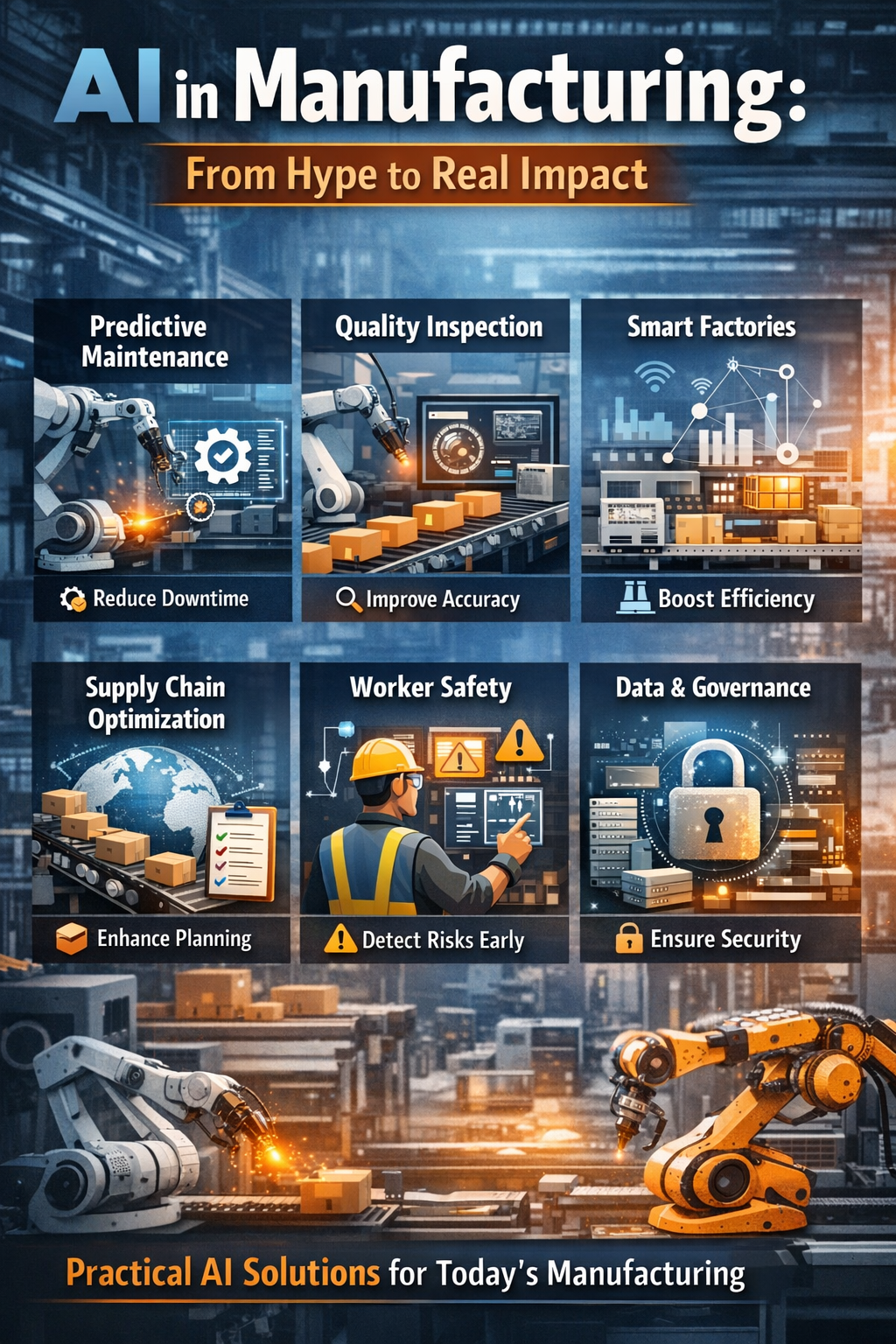
Predictive Maintenance
AI predicts equipment failures before they occur. This reduces downtime and extends asset life.
Quality Management
Computer vision systems detect defects quickly and consistently, improving product quality.
Smart Factories
Connected systems monitor operations in real time, improving efficiency and throughput.
Supply Chain Optimization
AI improves forecasting and visibility, helping teams respond faster to disruptions.
Product Design
Generative models create multiple design options based on constraints and goals.
Worker Productivity and Safety
AI identifies risks early and supports workers with better tools and guidance.
These use cases are already delivering measurable results across the industry.
Common Challenges to Address Early
AI adoption is not just a technical effort. It requires operational readiness.
Key challenges include:
Fragmented data
Data must be aligned across systems before deploying AI.
Low trust in AI outputs
Teams need transparency and oversight to build confidence.
Risk to live production
AI should be tested in controlled environments before full rollout.
Governance and compliance
Clear ownership and auditability are essential.
Security concerns
Sensitive operational data must be protected.
Change management
Teams need time and support to adapt to new workflows.
Organizations that address these early see faster and smoother adoption.
What to Look for in AI Software
Effective AI solutions are built into core workflows, not added as an afterthought.
Key features to look for:
- Integration with existing systems and processes
- Role-based insights and user-friendly interfaces
- Built-in governance, security, and auditability
- Industry-specific capabilities and best practices
- Support for automation and workflow orchestration
Solutions that align with real operations deliver value faster.
The Future of AI in Manufacturing
AI is shifting manufacturing from periodic decision-making to continuous improvement.
Instead of relying on fixed planning cycles, organizations can:
- Adjust operations in real time
- Test assumptions continuously
- Respond faster to new data
Over time, AI also builds institutional knowledge. It learns from past outcomes and identifies subtle patterns that humans may miss.
This creates a system that improves with experience, not just scale.
The future is not about full automation. It is about deeper insight, faster learning, and better decisions.
Final Thoughts
AI is already improving how manufacturers operate. It reduces costs, improves quality, and supports safer environments.
The real value comes from applying it to practical use cases, supported by strong data and clear governance.
Start small. Focus on one use case. Build trust. Then scale.
That is how AI moves from promise to performance.